
Science Kit
Scientific Instrument
- Power Supplies and Transformers
- Training Kits for Communication Lab
- Digital Electronic Experiments Computer Principles
- Study of Multivibrators
- Characteristics Operational Amplifiers
- Verification of Network Theorem
- Amplifiers Kits
- Demonstration Models
- Verification of Various Laws and Conservation of Signal
- Semi Conductor Devices
- Laser Experiment
- Characteristics Of Vaccum Tubes
- E M Apparatus Instrument
- Microprocessors
- OPTO Electronic Devices Equipments
- Digital Measuring Instruments
- Nuclear Physics
- Test and Measuring Instruments
Educational Rock and Minerals
Biology Equipment
- Prepared Slides Equipments
- Plant Equipment
- Magnifier Equipment
- Animal Equipments
- Biotechnology Equipments
- Cell Equipments
- Classification Equipments
- Dissection Equipments
- Electrophoresis Equipments
- Enzyme Equipments
- Genetics and Inheritance Equipments
- Health Equipments
- Human Biology Equipments
- Microbiology Equipment
- Molecular Model Equipment
Soil Testing
Rock Testing
Best Lab Equipment
Educational Lab Equipment
Analytical Lab Instrument
- Electrochemistry Instruments
- Flame Photometer
- Pharmacology Instruments
- Tablet Making Machine
- Apparatus For Isolated Uterus Intestine
- Water Still
- B.O.D. Incubator
- Egg Incubator
- Incubator Bacteriological
- Drying Oven Industrial
- Hot Air Universal Oven
- Shaker
- Incubators
- Hot Plate
- Clean Air Equipments
- Baths
- Autoclaves
- Surveying Instruments
- Pipette Washer (Automatic)
- Tissue Homogeniser
- Moisture Meter
- Mortuary Chamber
- Soxhlet Extraction Unit
- Kjeldahl Units (Without Glass Part)
- pH Meters
- Conductivity Meter
- Salinity Meter
- Dissolved Oxygen Meters
- Turbidity Meters
- Colony Counter
- Moisture Titrator
- Fluorometer
- Dissolution Test Apparatus
- Friability Test Apparatus
- Pyrogen Testing Instrument
- Tap or Bulk Density Apparatus
- Leak Test Apparatus
- Flocculator Jar Test Apparatus
- Microprocessor Flame Photometers
- Pharmacy Laboratory Equipments
- Respiration Pumps
- Brodie Operating Tables
- Embalming Tables
- Rat Operating Tables
- Small Animal Operating Tables
- Animals Holders
- Animals Head Holders
- Pneumograph Stethographs
- Spirometers
- Benedict Roth Recording Spirometers
- Digital Respinometers
- Organ Baths
- Isolated Organ Baths Digitals
- Four Unit Organ Baths
- Perfusions Lagendroff Assembly
- Dubois Raymond Keys
- Simple Keys
- Induction Coils
- Student Induction Coils
- Variable Interrupters
- Mosses Ergographs
- Compass Aesthesiometers
- Hand Grip Dynamometers
- Skin Fold Calipers
- Macerators
- Tablet Polishing Pans
- Tablet Making Machines (Electrically Operated)
- Tablets Making Machine Motorised
- Tablets Making Machine Hand Operated
- Apparatus Isolated Uterus Intestine
- Clean Air Benches
- Bio Safety Cabinet
- Laboratory Fume Hoods
- Fumigation
- Environmental Growth Chamber
- Ovens
- Water Distillation Plant
- Water Baths
- Hot Plates Warming Tables
- Dry Block Digester
- Shaking Machines And Stirrers
- COD Digester
- General Laboratory Equipment
- Spectrophotometer
- pharmaceutical-instruments/Pharmacology Equipments
Laboratory Apparatus
Laboratory Equipments Supplies
Engineering Lab Equipment
- Metallurgical Equipment
- Survey Instruments
- Incinerator
- Razor Sharpener
- Heat Transfer Lab Equipment
- Fluid Mechanics Lab Equipment
- Civil Engineering Lab Equipment
- Charts
- Bottle Top Dispenser
- Adsorption in Packed Beds
- Botany Charts
- Zoology Chart
- Chemistry Charts
- Physics Charts
- General Science Charts
- Genetics and Evolution Charts
- Human Physiology Charts
- Life Sketch of Scientists
- Food And Nutrition
- Health Care Series
- Prevent Diseases
- First Aid Charts
- Yogasana Charts
- Mathematics Primary Charts
- Charts on Geography
- Changing Face of the Earth
- Man and Environment
- Weather Maps of India
- Alphabet Charts
- Special Charts
- Moral Story Charts
- Specials Roll ups
- Struggle For Indian Freedom
- National Integration Charts
- Life Sketch of Great Men
- English Teaching Charts
- English Grammar Charts
- Military Science
- Army, Police and NCC Charts
- Maps Charts
- State Maps Political
- Civil and Draughtsman Equipment
- Nautical Compass
- Survey Equipment
- Soil Testing Equipments
- Measuring Instruments
- Tripods Stands
- Portholes
- Nautical Sextants
- Prism Sets
- CNC Trainer Machine
- Training Workshop Labs
- Mechanical Engineering Lab Equipment
- Air Conditioning and Refrigeration
- Automotive and Transportation
- Building Material Testing
Maths Lab Equipment
Porcelain Ware
Hospital Lab Equipments
Anatomical Models
- Dental Models
- Skeletons For Medical Students
- ENT Models
- Cancer Model
- Diabetes Model
- Implant Models
- Brain Models, Neuro Models
- Liver and Gastro Models
- Gynae Models, Female Health, Utreus Models
- Four Stage Liver Models
- Special Models
- Arthritis Models
- Heart and Artery Models
- Ortho Models
- Heart and Lungs Models
- Nurse Training Models
- Life Support Training Models
- Human Models
- Anatomical Models Equipments
Vocational Training Laboratory Equipment
- Woodworking Workshop Machines
- Wood Workshop Portable Tool
- Plant Engineering and Welding Equipment
- Welding Equipment and Workshop Lab Machine
- Standard Welding Equipment Set
- Electrical Work Bench
- Workshop Tools
- Plumbing Workshop Instrument
- Concrete Laboratory
- Soil Mechanics
- Hydraulics and Pneumatics
- Metal Manufacturing Training Machine
- Washing Machines
- Textile Technology
Lab Glassware
- Watch Glass Soda
- Voltameters
- Stirrers
- Test Tubes and Thermometer Pockets
- Staining Jars Glassware
- Specimen Tubes and Vials
- Spirit Burners
- Screwthreads, Discs and Joints
- Screw Caps, Stoppers and Stopcocks
- Distillation
- Extractors
- Coplins Jars
- Condenser
- Chromatography Columns
- Bends
- Beakers and Flasks
- Laboratory Adapter Oscilloscope Kit
Electronics Lab Equipments
- Variac Dimmerstats
- Signal Generators
- Fiber Optic Trainers
- Digital Storage Oscilloscopes
- Digital Electronics Trainer
- Communication Trainer
- Breadboard Trainers
- Analog Electronics Trainer
- Oscilloscopes
- Power Electronics Trainers
- Electronic Fundamentals
- Audio and Visual Technology
- Radio and Telephone Communications
- Electrical Technology
- Wiring, Distribution and Protection
- Electrical Motor Control
- Data Acquisition, Instrumentation and Process Control
- Lighting and Building Control Systems
Lab Plasticware
Chemistry Lab Equipment
Physics Lab Equipment
- Measurement
- Magnetisms
- Heat
- AP Physics
- Physics Lab Equipments
- Atomic Physics Equipment
- Density Equipment
- Electricity Equipment
- Electromagnetism Equipment
- Electrostatics Equipment
- Energy Transfer Equipment
- Force Motion And Dynamic Equipment
- Mechanics Lab Equipment
- Light And Optics Equipment
- Renewable Energy Equipment
- Sound and Waves
- Education Kit
Geography Lab Models
Demonstration Equipment Manufacturer, Suppliers and Exporter in India
Jaincolab Manufacturers is a leading Demonstration Equipment Manufacturer, Supplier, and Exporter in India, United States, Indonesia, Brazil, Bangladesh, Mexico, Japan, Egypt, Philippines, Democratic Republic of the Congo, Vietnam, Iran, Turkey, Tanzania, United Kingdom, France, South Africa, Italy, Kenya, Colombia, Sudan, Uganda, South Korea, Argentina, Afghanistan, Yemen, Angola, Morocco, Poland, Uzbekistan, Mozambique, Malaysia, Ghana, Saudi Arabia, Peru, Madagascar, Côte d’Ivoire, Cameroon, Niger, Venezuela, Australia, Syria, Mali, Burkina Faso, Sri Lanka, Malawi, Zambia, Chad, Kazakhstan, Somalia, Chile, Senegal, Ecuador, Cambodia, Zimbabwe, Guinea, Benin, Rwanda, Burundi, Bolivia, South Sudan, Tunisia, Haiti, Belgium, Dominican Republic, Jordan, United Arab Emirates, Honduras, Tajikistan, Papua New Guinea, Portugal, Togo, Sierra Leone, Belarus, Laos, Turkmenistan, Libya, Kyrgyzstan, Nicaragua, Paraguay, Bulgaria, Serbia, Republic of the Congo, Lebanon, Liberia, Central African Republic, Palestine, Oman, Mauritania, New Zealand, Costa Rica, Kuwait, Panama, Croatia, Georgia, Eritrea, Mongolia, Uruguay, Qatar, Namibia, Bosnia and Herzegovina, Moldova, Armenia, Gambia, Jamaica, Lithuania, Albania, Gabon, Botswana, Lesotho, Guinea-Bissau, Slovenia, Equatorial Guinea, Latvia, North Macedonia, Bahrain, Trinidad and Tobago, Timor-Leste, Cyprus, Estonia, Eswatini, Mauritius, Djibouti, Fiji, Comoros, Solomon Islands, Guyana, Bhutan, Luxembourg, Suriname, Montenegro, Malta, Maldives, Cabo Verde, Brunei, Belize, Bahamas, Iceland, Vanuatu, Barbados, São Tomé and Príncipe, Samoa, Saint Lucia, Kiribati, Seychelles, Grenada, Saint Vincent and the Grenadines, Antigua and Barbuda.
What chemistry demonstrations are in this range?
The range has seven demonstration kits for the teacher's bench. Four show colour changes: a traffic light redox reaction, an iodine clock, an equilibrium shift and the reduction of vanadium. Three show materials forming: a silicate garden, nylon 6-10 pulled as a rope, and a bismuth-tin eutectic alloy. Every kit comes with instructions.
- Chemistry Demonstration The Silicate Garden
- Chemistry Demonstration Nylon 6-10 Rope Trick
- Traffic Light Reaction Demo Lab
- Clock Reaction Demonstration
- Chemistry Demonstration Le Chateliers Principle
- Chemistry Demonstration Formation of Eutectic Alloys
- Chemistry Demonstration Colourful Vanadium
Demonstrations grouped by what they show
| Group | Items | What it covers |
|---|---|---|
| Colour-change reactions | Traffic Light Reaction Demo Lab, Clock Reaction Demonstration, Chemistry Demonstration Le Chateliers Principle, Chemistry Demonstration Colourful Vanadium | Redox, reaction rate, equilibrium and oxidation states shown by colour |
| Crystals, polymers and alloys | Chemistry Demonstration The Silicate Garden, Chemistry Demonstration Nylon 6-10 Rope Trick, Chemistry Demonstration Formation of Eutectic Alloys | Crystal growth in a chemical garden, polymer made at a liquid interface, and a low-melting alloy |
Colour-change demonstrations compared
| Product | Chemistry shown | What the class sees | Supplied for |
|---|---|---|---|
| Traffic Light Reaction Demo Lab | Redox colour change | Pale yellow, red, then green | Not listed |
| Clock Reaction Demonstration | Iodine clock reaction, modified version | Colourless mixture turns dark blue after a delay; heat and stronger solutions shorten it, dilution lengthens it | Not listed |
| Chemistry Demonstration Le Chateliers Principle | Shift of an equilibrium | Shown on an overhead projector | Five demonstrations |
| Chemistry Demonstration Colourful Vanadium | Reduction of vanadium in several steps | A sequence of distinct colours | Five demonstrations |
Crystal, polymer and alloy demonstrations compared
| Product | Chemistry shown | Materials or vessel | Supplied for |
|---|---|---|---|
| Chemistry Demonstration The Silicate Garden | Crystal growth in a silicate (chemical) garden | Glass jar or beaker needed, not included | Five demonstrations |
| Chemistry Demonstration Nylon 6-10 Rope Trick | Interfacial polymerisation of nylon 6-10 | Reagents supplied | Five demonstrations |
| Chemistry Demonstration Formation of Eutectic Alloys | Formation of a eutectic alloy | Bismuth and tin | Five demonstrations |
How to choose a chemistry demonstration
- To open a lesson on reaction rates, use the clock reaction. Change the temperature or the strength of the solution and the class sees the delay change.
- For redox and oxidation states, the traffic light reaction and the vanadium kit both show a run of colours from one mixture.
- For equilibrium, the Le Chatelier kit is set up for an overhead projector, so a whole room can see the shift.
- For polymers, the nylon 6-10 rope trick pulls a continuous strand from the boundary between two liquids.
- For crystals and metals, choose the silicate garden or the eutectic alloy kit. The silicate garden needs your own glass jar or beaker.
Lessons these demonstrations support
| Lesson topic | Products used |
|---|---|
| Factors that change the rate of a reaction | Clock Reaction Demonstration |
| Oxidation, reduction and colour | Traffic Light Reaction Demo Lab, Chemistry Demonstration Colourful Vanadium |
| Reversible reactions and equilibrium | Chemistry Demonstration Le Chateliers Principle |
| Condensation polymers | Chemistry Demonstration Nylon 6-10 Rope Trick |
| Crystal growth and alloys | Chemistry Demonstration The Silicate Garden, Chemistry Demonstration Formation of Eutectic Alloys |
Who uses these demonstration kits
Chemistry teachers in secondary schools and colleges use these kits at the front of the class to introduce a topic. Science clubs and open days use the colour changes and the nylon rope to show chemistry to visitors.
Ordering demonstration kits
Five of the kits list reagents or material for five demonstrations; the traffic light and clock reaction pages do not give a number. To order, send the kit names and the number of each through our contact page.
Other chemistry ranges for the school lab
These demonstrations belong to the Chemistry Lab Equipment range from JaincoLab, a chemistry lab equipment manufacturer in India.
| Range | What it covers |
|---|---|
| Chemistry Equipment | Bunsen burners, retort stands and clamps, centrifuges, balances and weighing scales, meters, magnets and beakers |
| Environmental Chemistry Equipment | Kits on nitrates, phosphates and eutrophication and on acid rain and weathering, with periodic table magnetic cards |
| Green Chemistry Equipment | Kits on water filtration, detergents, wastewater remediation, biodiesel, a hydrogen fuel cell and a greener aspirin synthesis |
| Lab Equipment | Hotplates and stirrers, distillation glassware, cells and electrodes, voltameters, centrifuges, organic chemistry kits and a muffle furnace |
| Lab Investigation Equipment | Consumer chemistry kits on acids and pH, antacids, soaps and detergents, kitchen chemistry and rusting |
| Materials | Slime, putty, instant snow, smart materials and sample packs, plus cement and concrete test apparatus |
| Micro Chemistry Equipment | Microscale student kits, combo plates, micro burettes, worksheets, thermometers and handheld colorimeters |
| Micro Science Equipment | Microscale student kits, topic science kits such as electricity, magnets and springs, and water monitoring kits |
| Model Sets | Molecular model sets for organic, inorganic and crystal structures, atomic orbital sets and polystyrene balls |
Frequently Asked Questions
Why does the clock reaction turn blue all at once?
Iodine forms slowly but is used up at once by a second chemical in the mixture. When that chemical runs out, iodine builds up and meets the starch, and the whole mixture turns dark blue together.
How can I change the delay in the clock reaction?
Warm the solutions or make them more concentrated and the colour appears sooner. Dilute them and it takes longer. Students can time several mixtures and plot the delay against concentration.
How does the nylon rope form?
The two reagents sit in separate liquids that do not mix. Nylon forms only where they meet, as a thin film at the boundary. Lift the film with tweezers and fresh nylon forms below it as you pull the rope.
What precautions apply to the nylon rope trick?
One of the solutions uses an organic solvent, so keep flames away and work in a well-ventilated room. Wear goggles and gloves, and rinse the nylon in water before anyone handles it.
How many times can each kit be used?
The silicate garden, nylon, Le Chatelier, eutectic alloy and vanadium kits each hold reagents or material for five demonstrations. The traffic light and clock reaction pages do not list a number.
For a quotation, list the demonstration kits and the quantity of each you need and send it through our contact page. For tender or project supply, see our tenders page.

Chemistry Demonstration The Silicate Garden
Product Code : JA-DE-6736
Silicate garden chemistry demonstration (SKU JA-DE-6736): a classroom kit in which coloured crystals added to a clear solution grow into plant-like structures within minutes; reagents for five demonstrations and instructions. Supplied by JaincoLab.
View Details
Chemistry Demonstration Nylon 6-10 Rope Trick
Product Code : JA-DE-6735
Nylon 6-10 rope trick chemistry demonstration (SKU JA-DE-6735): a polymer-chemistry kit in which a continuous strand of nylon is drawn from the interface of two solutions; reagents for five demonstrations and instructions. Supplied by JaincoLab.
View Details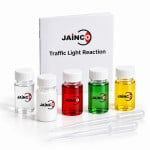
Traffic Light Reaction Demo Lab
Product Code : JA-DE-6739
Traffic light reaction demonstration (SKU JA-DE-6739): a redox demonstration in which a pale yellow liquid in a flask turns red when gently swirled and green when shaken, with instructions for classroom use. Supplied by JaincoLab.
View Details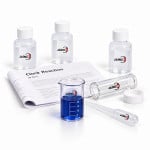
Clock Reaction Demonstration
Product Code : JA-DE-6738
Clock reaction demonstration (SKU JA-DE-6738): a modified iodine clock kit in which two colourless solutions are mixed and, after a delay, suddenly turn dark blue; the delay changes with temperature and concentration. Supplied by JaincoLab.
View Details
Chemistry Demonstration Le Chateliers Principle
Product Code : JA-DE-6732
Le Chatelier's principle demonstration (SKU JA-DE-6732): an overhead-projector kit showing how a chemical system at equilibrium shifts when conditions are changed; reagents for five demonstrations and instructions. Supplied by JaincoLab.
View Details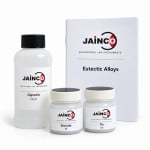
Chemistry Demonstration Formation of Eutectic Alloys
Product Code : JA-DE-6730
Eutectic alloy chemistry demonstration (SKU JA-DE-6730): bismuth and tin are heated together to their eutectic point to form a low-melting alloy; materials for five demonstrations and instructions. Supplied by JaincoLab.
View Details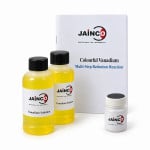
Chemistry Demonstration Colourful Vanadium
Product Code : JA-DE-6727
Colourful vanadium demonstration (SKU JA-DE-6727): a multi-step reduction of vanadium compounds showing a sequence of distinct colours as the vanadium is reduced; reagents for five demonstrations and instructions. Supplied by JaincoLab.
View Details