
Science Kit
Scientific Instrument
- Power Supplies and Transformers
- Training Kits for Communication Lab
- Digital Electronic Experiments Computer Principles
- Study of Multivibrators
- Characteristics Operational Amplifiers
- Verification of Network Theorem
- Amplifiers Kits
- Demonstration Models
- Verification of Various Laws and Conservation of Signal
- Semi Conductor Devices
- Laser Experiment
- Characteristics Of Vaccum Tubes
- E M Apparatus Instrument
- Microprocessors
- OPTO Electronic Devices Equipments
- Digital Measuring Instruments
- Nuclear Physics
- Test and Measuring Instruments
Educational Rock and Minerals
Biology Equipment
- Prepared Slides Equipments
- Plant Equipment
- Magnifier Equipment
- Animal Equipments
- Biotechnology Equipments
- Cell Equipments
- Classification Equipments
- Dissection Equipments
- Electrophoresis Equipments
- Enzyme Equipments
- Genetics and Inheritance Equipments
- Health Equipments
- Human Biology Equipments
- Microbiology Equipment
- Molecular Model Equipment
Soil Testing
Rock Testing
Best Lab Equipment
Educational Lab Equipment
Analytical Lab Instrument
- Electrochemistry Instruments
- Flame Photometer
- Pharmacology Instruments
- Tablet Making Machine
- Apparatus For Isolated Uterus Intestine
- Water Still
- B.O.D. Incubator
- Egg Incubator
- Incubator Bacteriological
- Drying Oven Industrial
- Hot Air Universal Oven
- Shaker
- Incubators
- Hot Plate
- Clean Air Equipments
- Baths
- Autoclaves
- Surveying Instruments
- Pipette Washer (Automatic)
- Tissue Homogeniser
- Moisture Meter
- Mortuary Chamber
- Soxhlet Extraction Unit
- Kjeldahl Units (Without Glass Part)
- pH Meters
- Conductivity Meter
- Salinity Meter
- Dissolved Oxygen Meters
- Turbidity Meters
- Colony Counter
- Moisture Titrator
- Fluorometer
- Dissolution Test Apparatus
- Friability Test Apparatus
- Pyrogen Testing Instrument
- Tap or Bulk Density Apparatus
- Leak Test Apparatus
- Flocculator Jar Test Apparatus
- Microprocessor Flame Photometers
- Pharmacy Laboratory Equipments
- Respiration Pumps
- Brodie Operating Tables
- Embalming Tables
- Rat Operating Tables
- Small Animal Operating Tables
- Animals Holders
- Animals Head Holders
- Pneumograph Stethographs
- Spirometers
- Benedict Roth Recording Spirometers
- Digital Respinometers
- Organ Baths
- Isolated Organ Baths Digitals
- Four Unit Organ Baths
- Perfusions Lagendroff Assembly
- Dubois Raymond Keys
- Simple Keys
- Induction Coils
- Student Induction Coils
- Variable Interrupters
- Mosses Ergographs
- Compass Aesthesiometers
- Hand Grip Dynamometers
- Skin Fold Calipers
- Macerators
- Tablet Polishing Pans
- Tablet Making Machines (Electrically Operated)
- Tablets Making Machine Motorised
- Tablets Making Machine Hand Operated
- Apparatus Isolated Uterus Intestine
- Clean Air Benches
- Bio Safety Cabinet
- Laboratory Fume Hoods
- Fumigation
- Environmental Growth Chamber
- Ovens
- Water Distillation Plant
- Water Baths
- Hot Plates Warming Tables
- Dry Block Digester
- Shaking Machines And Stirrers
- COD Digester
- General Laboratory Equipment
- Spectrophotometer
- pharmaceutical-instruments/Pharmacology Equipments
Laboratory Apparatus
Laboratory Equipments Supplies
Engineering Lab Equipment
- Metallurgical Equipment
- Survey Instruments
- Incinerator
- Razor Sharpener
- Heat Transfer Lab Equipment
- Fluid Mechanics Lab Equipment
- Civil Engineering Lab Equipment
- Charts
- Bottle Top Dispenser
- Adsorption in Packed Beds
- Botany Charts
- Zoology Chart
- Chemistry Charts
- Physics Charts
- General Science Charts
- Genetics and Evolution Charts
- Human Physiology Charts
- Life Sketch of Scientists
- Food And Nutrition
- Health Care Series
- Prevent Diseases
- First Aid Charts
- Yogasana Charts
- Mathematics Primary Charts
- Charts on Geography
- Changing Face of the Earth
- Man and Environment
- Weather Maps of India
- Alphabet Charts
- Special Charts
- Moral Story Charts
- Specials Roll ups
- Struggle For Indian Freedom
- National Integration Charts
- Life Sketch of Great Men
- English Teaching Charts
- English Grammar Charts
- Military Science
- Army, Police and NCC Charts
- Maps Charts
- State Maps Political
- Civil and Draughtsman Equipment
- Nautical Compass
- Survey Equipment
- Soil Testing Equipments
- Measuring Instruments
- Tripods Stands
- Portholes
- Nautical Sextants
- Prism Sets
- CNC Trainer Machine
- Training Workshop Labs
- Mechanical Engineering Lab Equipment
- Air Conditioning and Refrigeration
- Automotive and Transportation
- Building Material Testing
Maths Lab Equipment
Porcelain Ware
Hospital Lab Equipments
Anatomical Models
- Dental Models
- Skeletons For Medical Students
- ENT Models
- Cancer Model
- Diabetes Model
- Implant Models
- Brain Models, Neuro Models
- Liver and Gastro Models
- Gynae Models, Female Health, Utreus Models
- Four Stage Liver Models
- Special Models
- Arthritis Models
- Heart and Artery Models
- Ortho Models
- Heart and Lungs Models
- Nurse Training Models
- Life Support Training Models
- Human Models
- Anatomical Models Equipments
Vocational Training Laboratory Equipment
- Woodworking Workshop Machines
- Wood Workshop Portable Tool
- Plant Engineering and Welding Equipment
- Welding Equipment and Workshop Lab Machine
- Standard Welding Equipment Set
- Electrical Work Bench
- Workshop Tools
- Plumbing Workshop Instrument
- Concrete Laboratory
- Soil Mechanics
- Hydraulics and Pneumatics
- Metal Manufacturing Training Machine
- Washing Machines
- Textile Technology
Lab Glassware
- Watch Glass Soda
- Voltameters
- Stirrers
- Test Tubes and Thermometer Pockets
- Staining Jars Glassware
- Specimen Tubes and Vials
- Spirit Burners
- Screwthreads, Discs and Joints
- Screw Caps, Stoppers and Stopcocks
- Distillation
- Extractors
- Coplins Jars
- Condenser
- Chromatography Columns
- Bends
- Beakers and Flasks
- Laboratory Adapter Oscilloscope Kit
Electronics Lab Equipments
- Variac Dimmerstats
- Signal Generators
- Fiber Optic Trainers
- Digital Storage Oscilloscopes
- Digital Electronics Trainer
- Communication Trainer
- Breadboard Trainers
- Analog Electronics Trainer
- Oscilloscopes
- Power Electronics Trainers
- Electronic Fundamentals
- Audio and Visual Technology
- Radio and Telephone Communications
- Electrical Technology
- Wiring, Distribution and Protection
- Electrical Motor Control
- Data Acquisition, Instrumentation and Process Control
- Lighting and Building Control Systems
Lab Plasticware
Chemistry Lab Equipment
Physics Lab Equipment
- Measurement
- Magnetisms
- Heat
- AP Physics
- Physics Lab Equipments
- Atomic Physics Equipment
- Density Equipment
- Electricity Equipment
- Electromagnetism Equipment
- Electrostatics Equipment
- Energy Transfer Equipment
- Force Motion And Dynamic Equipment
- Mechanics Lab Equipment
- Light And Optics Equipment
- Renewable Energy Equipment
- Sound and Waves
- Education Kit
Geography Lab Models
Voltameters Manufacturer, Suppliers and Exporter in India
Jaincolab Manufacturers is a leading Voltameters Manufacturer, Supplier, and Exporter in India, United States, Indonesia, Brazil, Bangladesh, Mexico, Japan, Egypt, Philippines, Democratic Republic of the Congo, Vietnam, Iran, Turkey, Tanzania, United Kingdom, France, South Africa, Italy, Kenya, Colombia, Sudan, Uganda, South Korea, Argentina, Afghanistan, Yemen, Angola, Morocco, Poland, Uzbekistan, Mozambique, Malaysia, Ghana, Saudi Arabia, Peru, Madagascar, Côte d’Ivoire, Cameroon, Niger, Venezuela, Australia, Syria, Mali, Burkina Faso, Sri Lanka, Malawi, Zambia, Chad, Kazakhstan, Somalia, Chile, Senegal, Ecuador, Cambodia, Zimbabwe, Guinea, Benin, Rwanda, Burundi, Bolivia, South Sudan, Tunisia, Haiti, Belgium, Dominican Republic, Jordan, United Arab Emirates, Honduras, Tajikistan, Papua New Guinea, Portugal, Togo, Sierra Leone, Belarus, Laos, Turkmenistan, Libya, Kyrgyzstan, Nicaragua, Paraguay, Bulgaria, Serbia, Republic of the Congo, Lebanon, Liberia, Central African Republic, Palestine, Oman, Mauritania, New Zealand, Costa Rica, Kuwait, Panama, Croatia, Georgia, Eritrea, Mongolia, Uruguay, Qatar, Namibia, Bosnia and Herzegovina, Moldova, Armenia, Gambia, Jamaica, Lithuania, Albania, Gabon, Botswana, Lesotho, Guinea-Bissau, Slovenia, Equatorial Guinea, Latvia, North Macedonia, Bahrain, Trinidad and Tobago, Timor-Leste, Cyprus, Estonia, Eswatini, Mauritius, Djibouti, Fiji, Comoros, Solomon Islands, Guyana, Bhutan, Luxembourg, Suriname, Montenegro, Malta, Maldives, Cabo Verde, Brunei, Belize, Bahamas, Iceland, Vanuatu, Barbados, São Tomé and Príncipe, Samoa, Saint Lucia, Kiribati, Seychelles, Grenada, Saint Vincent and the Grenadines, Antigua and Barbuda.
What voltameter does this range list?
This range has 1 item: a voltameter, the electrolytic cell used for electrolysis practicals in school and college laboratories. Current passed through an electrolyte between two electrodes decomposes it, and the amount of product relates to the charge passed. The listing does not publish dimensions or electrode details; the full specification comes with the quotation.
What this voltameter range covers
| Group | Items | What it covers |
|---|---|---|
| Voltameter (electrolytic cell) | Voltameter | Electrolysis of acidified water and Faraday's law practicals |
What the voltameter listing gives
| Product | Type | Specification | Confirmed on the quotation |
|---|---|---|---|
| Voltameter | Voltameter (electrolytic cell) | Provided with the quotation | Power supplies, electrolytes and accessories |
What to check before ordering
- Experiment: say which practical the voltameter is for, such as electrolysis of acidified water or Faraday's laws. The specification offered is confirmed against it on the quotation.
- Copper deposition: for finding the electrochemical equivalent of copper, the Copper Volta meter in the physics range is the one to choose.
- Circuit: a DC supply, an Ammeter and a Rheostats (Nichrome Type) complete the circuit. Power supplies and electrolytes are confirmed on the quotation.
- Number of sets: count one voltameter for each student group, plus one for demonstration.
Electrolysis practicals covered
| Task | Products used |
|---|---|
| Decomposing acidified water and collecting the gases | Voltameter or the Hoffman Voltameter (PTFE) with electrodes |
| Verifying Faraday's laws of electrolysis | Voltameter with an Ammeter and a Digital Stop Watch |
| Finding the electrochemical equivalent of copper | Copper Volta meter |
| Electrolysis practicals in CBSE and ICSE chemistry and physics | Voltameter on a battery eliminator |
Who uses the voltameter
School chemistry and physics laboratories use it for CBSE and ICSE electrolysis practicals, as the product page states. Colleges use it to verify Faraday's laws and in B.Sc. electrochemistry practicals.
Ordering a voltameter
The specification is supplied with the quotation. When you enquire, name the experiment, the number of voltameters and whether you also need a power supply or electrolyte, through our contact page.
Other ranges in Lab Glassware
The voltameter belongs to the Lab Glassware range from JaincoLab, a laboratory glassware manufacturer in India.
| Range | What it covers |
|---|---|
| Beakers and Flasks | Squat and tall form beakers, Erlenmeyer conical flasks, round bottom flasks and filter flasks |
| Bends | Plain, recovery, receiver and vented bends, with socket, cone or vacuum connections |
| Chromatography Columns | A chromatography column with a sintered disc |
| Condenser | Air, Allihn, Graham coil, Davies double surface, jacketed coil and Liebig condensers |
| Coplins Jars | Coplin jars for staining microscope slides |
| Distillation | A Vigreux column and Claisen, splash and steam distillation heads |
| Extractors | Soxhlet extractors |
| Screw Caps, Stoppers and Stopcocks | Plastic caps, PTFE washers, rubber rings, and straight, burette, valve, T bore and vacuum stopcocks |
| Screwthreads, Discs and Joints | Cone, socket, spherical, screwthread and flat flange joints, sintered discs and joint clips |
| Specimen Tubes and Vials | Screw neck, rolled rim and wide mouth vials, and push-in caps |
| Spirit Burners | Alcohol and spirit burners |
| Staining Jars Glassware | Glass staining jars |
| Stirrers | Anchor, paddle and link stirrers, with stirrer glands, sleeves and guides |
| Test Tubes and Thermometer Pockets | Test tubes, drying tubes, air inlet tubes, thermometer pockets and thermometers with cone |
| Watch Glass Soda | Soda glass watch glasses |
Frequently Asked Questions
Why is twice as much gas collected at the cathode?
Water splits into hydrogen and oxygen in a two-to-one ratio by volume. Hydrogen collects over the cathode and oxygen over the anode. A reading slightly off this ratio is normal at first, as some oxygen dissolves in the water.
Why is acid added to the water?
Pure water conducts electricity poorly, so very little current flows. A little dilute sulphuric acid lets it conduct. The acid itself is not used up in the electrolysis.
How are the two gases identified?
Hold a lighted splint to the hydrogen and it burns with a squeaky pop. A glowing splint relights in the oxygen. Collect each gas in a test tube held mouth-down and test it straight away.
Why must the current stay steady in a Faraday's law experiment?
The charge passed is the current multiplied by the time. Adjust the rheostat to keep the ammeter reading constant, and time the run with a stopwatch. A drifting current makes the charge, and so the result, wrong.
For a quotation, name the experiment and the number of voltameters you need, and send it through our contact page. For tender or project supply, see our tenders page.
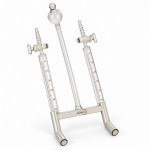
Voltameter
Product Code : JA-V-1700
Voltameter, product code JA-V-1700, an electrolytic cell used in school and college practicals to study electrolysis and the quantity of electricity passed. Detailed specifications are provided with the quotation.
View Details