Beaker Borosilicate 100 ml Manufacturer,Supplier and Exporter in India
Product Code : JL-LEP-10249
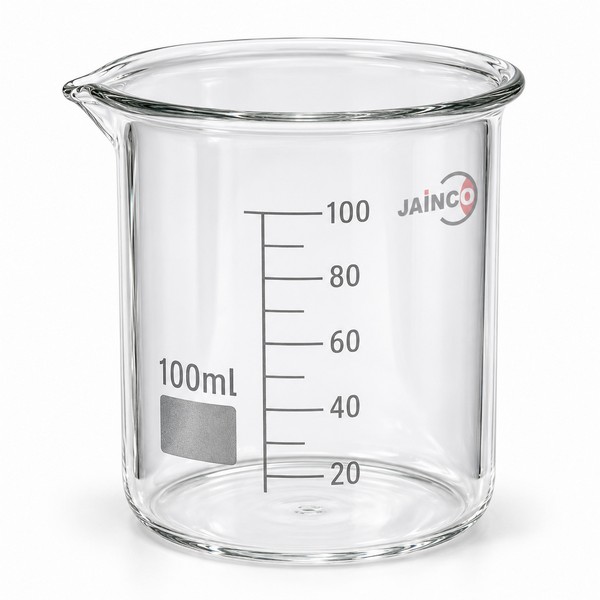
This 100 ml Griffin low form beaker is made of clear, bubble-free borosilicate glass. It has straight sides, a flat bottom and a small spout. Permanent white enamel marks run from 20 to 80 mL in 10 mL steps, next to a large marking spot. Group practicals use it for small reactions and for warming liquids.
Specifications of the 100 ml Griffin beaker
| Product code | JL-LEP-10249 |
|---|---|
| Type | Griffin low form, straight sides, flat bottom, small pouring spout |
| Material | Borosilicate glass, clear and bubble-free |
| Capacity | 100 mL (±5%), etched on the glass |
| Graduations | Permanent white enamel, 20 to 80 mL in 10 mL steps, single metric scale, large marking spot |
| Outside diameter | 50 to 52 mm |
| Height | 70 to 72 mm |
| Wall thickness | 1.5 to 2.0 mm |
| Heat resistance | Up to 500°C |
| Specification reference | As per DepEd guidelines |
| Manufacturer | JaincoLab, Ambala, India |
Using the 100 ml beaker in group practicals
- Neutralising an alkali. Put the dilute alkali in the beaker and add indicator with a dropper. Add the acid a little at a time, stirring with a glass stirring rod, and test the end point with litmus paper.
- Collecting a filtrate. Stand the beaker under a long stem funnel lined with folded filter paper. Let the stem touch the inside wall so the liquid runs down without splashing.
- Following a temperature. Warm the liquid gently on wire gauze and read it with a chemical thermometer. Keep the bulb in the liquid but off the hot base.
- Covering a solution. Rest a watch glass on the rim to keep dust out while a solution cools or crystals form.
Frequently Asked Questions
What does Griffin low form mean on a beaker?
It describes the shape. A Griffin beaker has straight sides, a flat bottom and a spout. Low form means it is wide for its height, so it stands firmly and is easy to stir in. A tall form beaker is narrower for the same volume.
How full should the 100 ml beaker be for heating or stirring?
Keep the liquid at or below the top mark, which is 80 mL. The space above it stops splashing while you stir. It also leaves room if the liquid froths or starts to boil.
How do I pour from the beaker without liquid running down the outside?
Pour slowly from the spout with a glass rod held against it. The liquid follows the rod into the next vessel instead of running down the glass. Hold back the last drops if a solid has settled.
How should the beaker be cleaned after a practical?
Rinse it soon after use, before anything dries on the glass. Wash it with warm water, a little detergent and a soft beaker brush. Rinse with tap water, then with distilled water, and leave it upside down to drain.
What is the white marking spot for?
It is a patch you can write on. Mark the solution or your group number there in pencil or marker. Then beakers on a shared bench do not get mixed up.
Which chemicals should not be left in a borosilicate beaker?
Borosilicate glass resists most acids, salt solutions and solvents used in school labs. Hydrofluoric acid attacks glass, and hot strong alkalis slowly etch it. Do not keep these in the beaker.
Other beaker sizes
See the Laboratory Equipment Products range and more glassware from JaincoLab, a laboratory glassware manufacturer in India.
For a quotation, send the product name and the quantity you need through our contact page. For tender or project supply, see our tenders page.