Beaker Borosilicate 50 ml Manufacturer,Supplier and Exporter in India
Product Code : JL-LEP-10251
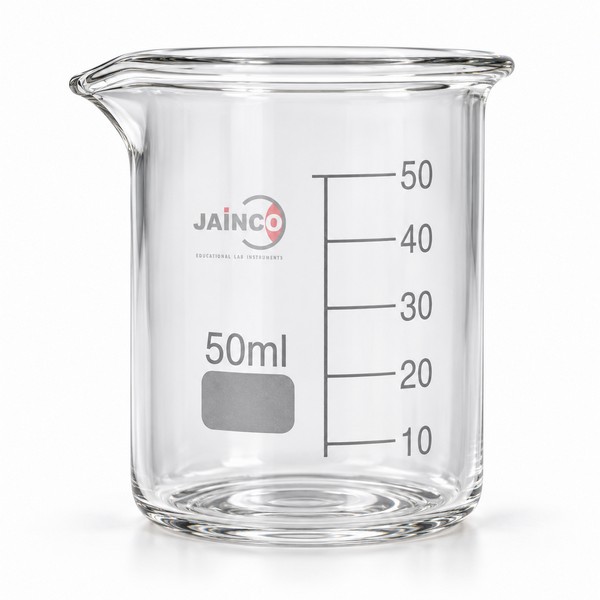
This 50 ml beaker is made of clear, bubble-free borosilicate glass, with straight sides, a flat bottom and a small pouring spout. Enamelled marks every 10 mL from 10 to 40 mL show the approximate volume. It is sized for preparing, mixing and warming small amounts of liquid in school and college chemistry practicals.
Specifications of the 50 ml borosilicate beaker
| Product code | JL-LEP-10251 |
|---|---|
| Material | Borosilicate glass, clear and bubble-free |
| Shape | Cylindrical, straight sides, flat bottom, small pouring spout |
| Capacity | 50 mL (±5%) |
| Graduations | Enamelled, 10 to 40 mL in 10 mL steps |
| Outside diameter | 40 to 42 mm |
| Height | 55 to 57 mm |
| Wall thickness | 1.5 to 2.0 mm |
| Heat resistance | Up to 500°C |
| Specification reference | As per DepEd guidelines |
| Manufacturer | JaincoLab, Ambala, India |
Using the 50 ml beaker in chemistry practicals
- Making a small volume of salt or indicator solution. Dissolve the solid in water in the beaker, stir with a glass rod, then make up the final volume in a Measuring Cylinder 25 ml.
- Warming a liquid. Stand the beaker on wire gauze over a tripod stand and heat it gently with a Bunsen burner.
- Class demonstrations. Students watch a solid dissolve or an indicator change colour, then the teacher pours the mixture into test tubes through the spout.
- Moving hot glass. Lift the beaker off the gauze with beaker tongs and let it cool in air before washing.
Frequently Asked Questions
Can the 50 ml beaker go straight into a Bunsen burner flame?
No. Stand it on wire gauze over a tripod stand. The gauze spreads the heat across the base, so the glass warms evenly. The beaker is listed for heating up to 500°C.
Why does a hot beaker sometimes crack?
Cracks usually come from a sudden change in temperature. Heat the beaker slowly, keep cold water off hot glass, and do not set it down on a cold, wet surface. Let it cool in air first.
Can I use the 10 mL marks to measure a volume for an experiment?
Only as a rough guide. The marks show an approximate volume. When a practical needs a measured volume, use a measuring cylinder, or a pipette or burette where closer accuracy is needed.
What is the difference between a beaker and a conical flask?
A beaker has straight sides and a spout, so it is easy to stir in and pour from. A conical flask narrows towards the neck. Its contents can be swirled without spilling, which suits titrations.
Is a chipped or scratched beaker still safe to heat?
No. Chips and deep scratches weaken the glass, and the beaker can crack when it is heated. Take it out of use and put it in the broken-glass bin.
Other beaker sizes
See the Laboratory Equipment Products range and more glassware from JaincoLab, a laboratory glassware manufacturer in India.
For a quotation, send the product name and the quantity you need through our contact page. For tender or project supply, see our tenders page.