Laboratory Test Tubes Manufacturer,Supplier and Exporter in India
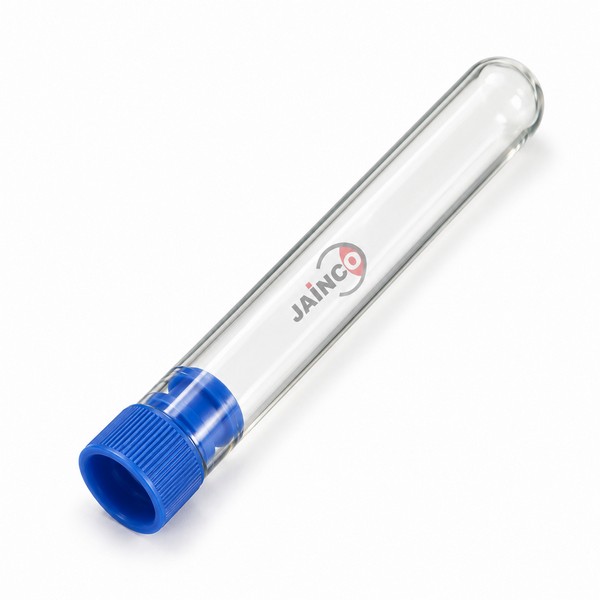
Product Code : JA-TTATP-1694
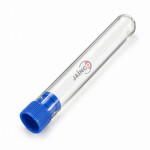
These laboratory test tubes have a ground-glass socket at the mouth. A condenser, adapter, stopper or gas inlet with a matching cone fits straight on. The tube then works as a small reaction vessel with jointed apparatus. Ten sizes are listed, from a 2 ml tube with a B10 socket to a 195 ml tube with a B34 socket.
Sizes of the jointed laboratory test tubes
| Product code | JA-TTATP-1694 |
|---|---|
| 2 ml tube | 65 mm high, 14 mm diameter, B10 socket |
| 5 ml tube | 100 mm high, 14 mm diameter, B10 socket |
| 11 ml tube | 100 mm high, 18 mm diameter, B14 socket |
| 15 ml tube | 18 mm diameter, B14 socket |
| 19 ml tube | 100 mm high, 23 mm diameter, B19 socket; or 150 mm high, 18 mm diameter, B14 socket |
| 31 ml tube | 150 mm high, 23 mm diameter, B19 socket |
| 54 ml tube | 150 mm high, 29 mm diameter, B24 socket |
| 75 ml tube | 200 mm high, 29 mm diameter, B24 socket |
| 195 ml tube | 250 mm high, 41 mm diameter, B34 socket |
| Manufacturer | JaincoLab, Ambala, India |
Using jointed test tubes for small-scale reactions
- Micro-scale reflux. Fit an air condenser into the socket, clamp the tube upright and warm it in a rectangular water bath. Vapour cools in the condenser and runs back into the tube.
- Reactions under a gas. A gas inlet adapter in the socket lets an inert gas sweep over the mixture. Leave an outlet open so that pressure cannot build up.
- Holding the joint. Fit a plastic joint clip of the matching size, so the condenser or adapter cannot slip out of the socket.
- Keeping small samples. Close the tube with a ground-glass stopper of the same joint size and stand it in a test tube stand.
Frequently Asked Questions
What do B10, B14 and B19 on the socket mean?
They are joint size codes. The number gives the rough width, in millimetres, of the wide end of the joint. Any cone with the same code fits the socket, whether it is a stopper, a condenser or an adapter.
Can a cone of a different size be fitted to the tube?
Not directly. The cone must match the socket size. Put a reduction or expansion adapter between the two joints, or choose the tube whose socket matches the glassware you already have.
How do I stop the ground-glass joint from sticking?
Keep both joint surfaces clean and dry. For heating or work under gas, wipe a very thin film of joint grease on the upper part of the cone. Take the joint apart soon after use, above all after alkaline solutions.
What should I do if the joint has seized?
Do not force or twist it hard, because the tube can snap in your hand. Soak the joint in warm water for a while, then tap it gently with a wooden handle. If it still does not move, pass it to the lab technician.
Why must the top of the condenser stay open during reflux?
Heating a closed system builds up pressure, and the glass can burst. Under reflux the vapour cools in the condenser and runs back, so little is lost with the top open. Never put a stopper on top.
How should the jointed tube be heated?
Clamp it upright and warm it gently, ideally in a water bath. Add an anti-bumping granule first, so the liquid boils smoothly and does not surge up into the condenser.
Other tubes and thermometer pockets in this range
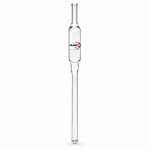
- Tubes, Drying, Angled
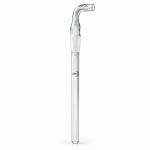
- Tubes and Air Inlets, Bent With Cone
- Tubes and Air Inlets, Straight With Cone
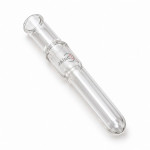
- Thermometer Pockets
See the Test Tubes and Thermometer Pockets range and more glassware from JaincoLab, a laboratory glassware manufacturer in India.
For a quotation, send the product name and the quantity you need through our contact page. For tender or project supply, see our tenders page.