30 MHz Oscilloscope Manufacturer,Supplier and Exporter in India
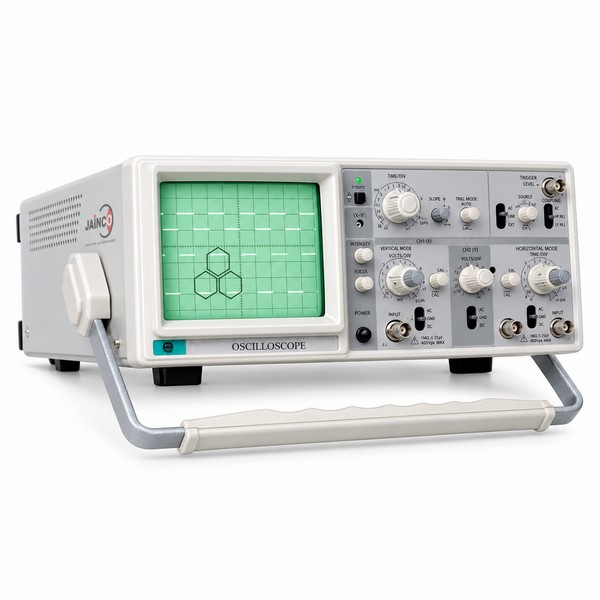
Product Code : JA-O-1407
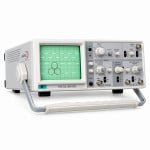
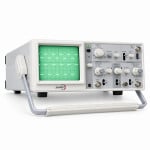
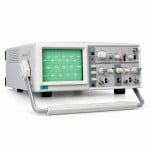
This 30 MHz oscilloscope is a dual trace analogue bench instrument with a cathode ray tube display. It shows how a voltage changes with time on two channels at once. Students read amplitude, time period and frequency from the screen and compare two waveforms side by side. It is used in electronics, physics and engineering laboratories.
Specifications of the 30 MHz dual trace oscilloscope
| Product code | JA-O-1407 |
|---|---|
| Bandwidth | DC to 30 MHz (-3 dB), rise time about 12 ns |
| Channels | 2 (dual trace), with CH1, CH2, ALT, CHOP and ADD modes, plus X-Y mode |
| Display | Rectangular cathode ray tube with internal graticule, 8 x 10 divisions of 1 cm |
| Probes and accessories | Two x1/x10 switchable probes, mains power cord and instruction manual |
| Vertical sensitivity and input | 5 mV/div to 5 V/div in 1-2-5 steps, 1 mV/div with the x5 magnifier; input impedance 1 megohm in parallel with 25 pF; maximum input 300 V (DC + AC peak) |
| Time base | 0.2 µs/div to 0.5 s/div in 1-2-5 steps, with x10 sweep magnifier |
| Trigger | AUTO, NORM, TV-V and TV-H modes; CH1, CH2, LINE and EXT sources |
| Calibrator output | 1 kHz square wave, 2 V peak-to-peak, for probe adjustment |
| Power supply | 230 V AC, 50 Hz |
| Supplied by | JaincoLab |
Using the 30 MHz dual trace oscilloscope in electronics practicals
- Checking the probes before a class. Clip each probe to the calibrator output, set it to x10 and adjust its trimmer until the square wave has flat tops.
- Amplifier gain. Feed a small sine wave from a Function Generator into the Two Stage RC Coupled Transistor Amplifier. Show the input on CH1 and the output on CH2, and keep the output free of clipping. Read the peak-to-peak voltage of each trace and divide the output by the input to find the gain.
- Rectifier waveforms. On the Half Wave, Full Wave and Rectifier Apparatus, show the AC fed to the diodes on CH1 and the rectified output on CH2. Clip both probe grounds to the common terminal and never probe the mains side. For the bridge circuit, connect one probe at a time, as the two ground clips are joined inside the scope. Repeat with the filter in circuit.
- Capacitor charging. Apply a square wave to the RC Circuit Transient Response board. Watch the capacitor voltage rise and fall on CH2 against the input on CH1.
Frequently Asked Questions
Is an instruction manual supplied with each oscilloscope we order?
Yes. Each oscilloscope is supplied with an instruction manual, two x1/x10 switchable probes, one for each channel, and a mains power cord. Your staff can adjust both probes against the built-in calibrator output when the unit is unpacked.
Should the oscilloscope probe be set to x1 or x10?
Use x10 for most work. It loads the circuit less and keeps the full bandwidth of the scope. The signal is divided by 10, so multiply the volts/div reading by 10. Switch to x1 only for very small, slow signals.
When should I use ALT mode and when CHOP mode?
Use ALT at fast time base settings. It draws CH1 and CH2 on alternate sweeps, which looks steady when sweeps are quick. At slow settings ALT flickers, so switch to CHOP. It switches rapidly between the channels during each sweep, so both traces appear together.
How do you measure the phase difference between two signals on a dual trace oscilloscope?
Put the reference signal on CH1 and trigger from CH1. Put the second signal on CH2 and centre both traces on the same line. Count the divisions between matching zero crossings. Divide this shift by the divisions for one full cycle, then multiply by 360 to get degrees.
Which specifications should we check when buying this oscilloscope against a tender?
Match the tender line by line with the table on this page. Check bandwidth and rise time, channels, display, vertical sensitivity, input impedance, time base, trigger, probes and mains supply. Quote the product code JA-O-1407 in your bid papers. Send tender documents through our tenders page.
Which HS code applies when importing a 30 MHz oscilloscope?
Cathode ray oscilloscopes are generally classified under HS subheading 9030.20, oscilloscopes and oscillographs. Each country adds its own digits after the first six, so your customs broker fixes the full tariff line. For an export order, send the product code and quantity through our contact page.
Other instruments in the oscilloscopes range
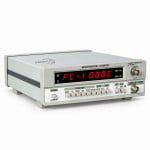
See the Oscilloscopes range and more electronics lab equipment from JaincoLab, an electronics lab equipment manufacturer in India.
For a quotation, send the product name and the quantity you need through our contact page. For tender or project supply, see our tenders page.