Solar Energy Demonstrator Manufacturer,Supplier and Exporter in India
Product Code : JA-LABCS-9623
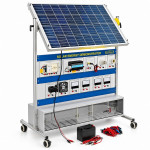
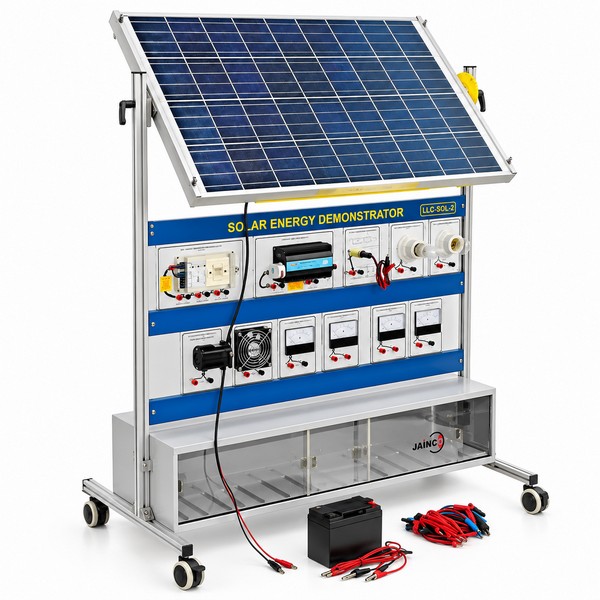
The Solar Energy Demonstrator shows students how electrical power is generated from sunlight with solar cells. It covers how a solar cell works, how the energy is stored in a battery and how DC from the battery is converted to AC. It gives a practical foundation in solar electric technology.
Specifications of the Solar Energy Demonstrator
| Product code | JA-LABCS-9623 |
|---|---|
| Topics covered | Solar cell operation, battery storage and DC to AC conversion |
| Solar module | One photovoltaic module of about 40 to 90 W, 12 V class, on a frame with adjustable tilt |
| Charge controller | 12 V solar charge controller with indicators for charging, float and load-cut states |
| Battery | 12 V deep-cycle lead-acid battery |
| Inverter | DC to AC inverter of about 100 to 300 W with a 230 V AC output |
| Loads | Switchable 12 V DC lamps, an AC lamp on the inverter output and a variable resistive load |
| Meters | Voltmeter and ammeters for the panel, battery and load, and a solar radiation (irradiance) meter |
| Indoor light source | Halogen lamp bank, as an option, for tests when there is no sunshine |
| Typical exercises | Irradiance, open-circuit voltage and short-circuit current, the I-V curve, battery charging, DC and AC loads and inverter testing |
| Supplied by | JaincoLab |
Using the Solar Energy Demonstrator in practical classes
- I-V curve of the module. In steady sunlight, record the open-circuit voltage and the short-circuit current with a Digital Multimeter. Then step the variable load and plot current against voltage to find the maximum power point.
- Light level and tilt. Tilt the module through several angles and note the irradiance and the short-circuit current at each one. A Digital Lux Meter gives a quick relative check of the light level on the module.
- One cell and a full module. Measure a single cell on the Solar Cell Characteristics Apparatus. Compare its open-circuit voltage with that of the module and work out how many cells are in series.
- DC to AC conversion. Run the AC lamp from the inverter and note the battery current before and after switching it on. To study how an inverter circuit switches DC into AC, continue on the DC To AC Inverter.
Frequently Asked Questions
Does a small solar demonstrator need an MPPT charge controller, or is PWM enough?
PWM is enough at this size. With a 12 V class module charging a 12 V battery, an MPPT controller gains little extra energy. MPPT pays off on larger arrays, or when the module voltage is much higher than the battery voltage.
How is the temperature coefficient used to estimate panel output on a hot day?
The module datasheet gives a power temperature coefficient as a small negative percentage per degree Celsius. Multiply it by how far the cell temperature is above the standard test temperature, then reduce the rated power by that percentage. Measure the module itself, as cells in sun run much hotter than the air.
Can the demonstrator be run indoors with lamps instead of sunlight?
Yes, with the optional halogen lamp bank. The lamp light has a different spectrum from sunlight, so readings will not match outdoor values exactly. Keep the lamp distance fixed between groups, and let the lamps and the module cool before anyone touches them.
Why must battery polarity be checked before the charge controller is connected?
A battery connected the wrong way round can blow the fuse or damage the charge controller at once. Check the polarity with a meter first. Connect the battery to the controller before the module, so the controller can detect the system voltage.
Which meters should come with a solar demonstrator for student measurements?
Students need a voltmeter, and ammeters for the panel, battery and load circuits, plus a solar radiation meter for the light level. A digital multimeter helps with checks. List these instruments in your tender so every set arrives complete. Send the tender through our tenders page.
Can the demonstrator be shown to our purchase committee before we accept it?
Yes. A JaincoLab team can demonstrate the unit to your purchase committee or at your school, and service engineers install it at your site. A sample unit can also be sent with the quotation if required. Arrange this through our contact page.
Other solar energy trainers in the range
See the Lighting and Building Control Systems range and more electronics lab equipment from JaincoLab, an electronics lab equipment manufacturer in India.
For a quotation, send the product name and the quantity you need through our contact page. For tender or project supply, see our tenders page.