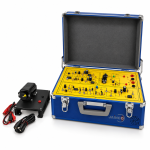
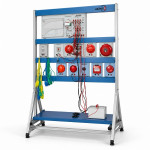
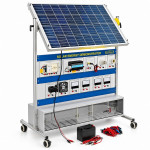
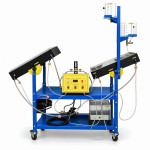
Solar Heat Energy Trainer Manufacturer,Supplier and Exporter in India
Product Code : JA-LABCS-9620
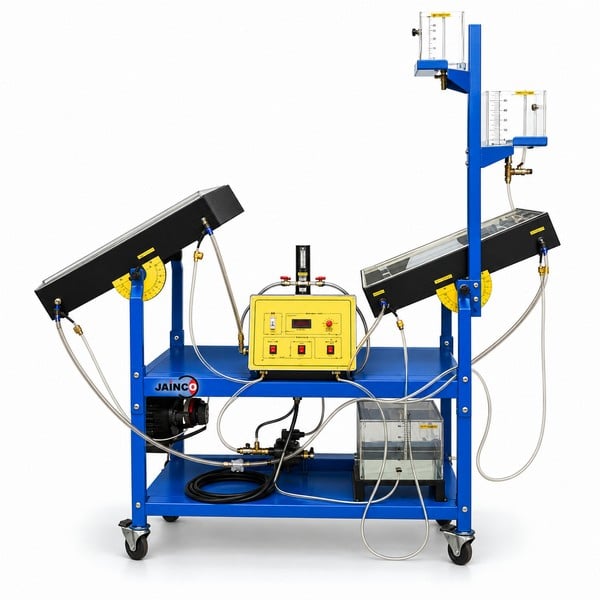
The Solar Heat Energy Trainer is a compact unit for classroom and remote-site use. Students measure the heat that a solar panel absorbs, in kcal or BTU, and work out the panel's heat-absorbing capacity. Basic activities come first, followed by more advanced tasks on collector angle, light intensity and heat losses.
Specifications of the Solar Heat Energy Trainer
| Product code | JA-LABCS-9620 |
|---|---|
| Topic | Solar heat absorption, measured in kcal or BTU |
| Design | Small and compact, for classroom and remote-site use |
| Collector | Small flat plate collector with a black metal absorber, a glass cover and an insulated back |
| Absorber size | About 320 x 330 mm to 300 x 400 mm of absorbing surface |
| Tilt adjustment | Collector angle adjustable, to face the light |
| Temperature measurement | Water temperature at the collector inlet and outlet |
| Activities and results | Basic activities first, then more advanced tasks: heat absorbed from flow, specific heat and temperature rise; collector efficiency and heat losses |
| Supplied by | JaincoLab |
Solar heat experiments with the trainer
- Heat gained by the water. Read the inlet and outlet water temperatures with a Digital Stem Thermometer. Collect the water leaving the collector for a timed period, using a Digital Stop Watch, and weigh it to find the mass flow.
- Light intensity. Indoors, set a lamp at several distances from the collector and check the light level at the absorber with a Digital Lux Meter. Plot the heat collected against the light level. Lamps get hot, so move the lamp only by its stand and keep hands clear of the housing.
- Collector angle. Set the collector to several tilt angles under the same light and record the temperature rise at each one. Find the angle that gives the most heat.
Frequently Asked Questions
Why does a glass cover help a solar collector hold more heat?
Glass lets short-wave sunlight through to the black absorber, but it blocks most of the long-wave heat that the warm plate gives off. It also stops wind and room air from cooling the plate. This greenhouse effect keeps more of the heat in the water.
How is the heat absorbed by the collector worked out in kcal?
Multiply the mass of water that passed through the collector, in kilograms, by its rise in temperature in degrees Celsius. Water needs one kcal to warm one kilogram by one degree, so the answer comes out directly in kcal. One kcal is just under four BTU.
What does the efficiency of a solar collector tell students?
Efficiency is the share of the solar energy falling on the collector that ends up as useful heat in the water. It falls as the plate gets hotter than the surrounding air, because more heat is lost. Students use it to compare angles, flow rates and covers on equal terms.
How does the tilt angle of the collector change the heat it collects?
The collector gathers the most heat when the light strikes it at right angles. Outdoors, face it towards the equator and tilt it at roughly the local latitude for year-round use. Indoors, set a lamp so that its beam falls square onto the absorber.
Can the trainer be matched line by line to the specification in our tender?
Yes. JaincoLab can quote equivalents for the items on a lab list. Where a line of your specification differs from the standard unit, the trainer can be built to your own technical specification. Send the specification through our tenders page.
Where should temperature, flow and radiation be measured on a solar heat trainer?
Ask for water temperature sensors at the collector inlet and outlet, plus an ambient air sensor. Add a flow sensor in the water line and a radiation sensor in the plane of the collector. With these points, students can work out both the heat gained and the efficiency. State them in your tender.
Other solar energy trainers in the range
JaincoLab supports tender contractors as well as institutions: we manufacture and export laboratory equipment for Ministry of Education projects, World Bank-funded tenders and United Nations programmes, executed successfully in many countries, and we specialise in turnkey laboratory set-ups. Contact us through the tenders page early in your bid preparation.
See the Lighting and Building Control Systems range and more electronics lab equipment from JaincoLab, an electronics lab equipment manufacturer in India.
For a quotation, send the product name and the quantity you need through our contact page. For tender or project supply, see our tenders page.