Training System for DDC Control Manufacturer,Supplier and Exporter in India
Product Code : JA-LABCS-9624
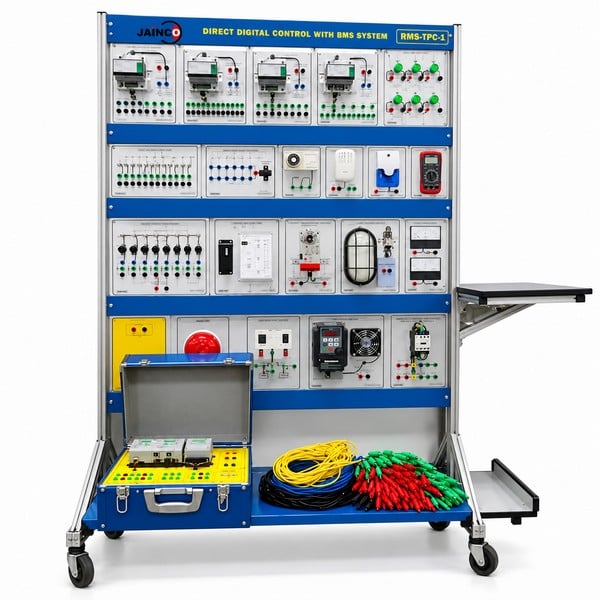
The Training System for DDC Control teaches how direct digital control systems run building services such as heating, cooling, lighting, electrical and security systems. The same controllers are also used in industrial processes. Students start with the basics and move on to realistic applications, configuring, programming and setting up the DDC units themselves.
Specifications of the DDC control training system
| Product code | JA-LABCS-9624 |
|---|---|
| Applications covered | Building services (heating, cooling, lighting, electrical and security) and industrial processes |
| Controller | Programmable DDC controller with universal inputs (0 to 10 V, 4 to 20 mA, resistance or thermistor, dry contact), binary inputs, analogue outputs and relay or triac binary outputs |
| Typical I/O per controller | 6 to 8 universal inputs, 2 to 4 binary inputs, 2 to 4 analogue outputs (0 to 10 V) and 3 to 6 binary outputs |
| Communication | BACnet over Ethernet (BACnet/IP) to a supervisory PC |
| Sensors | Temperature, humidity, carbon dioxide and occupancy sensors |
| Actuators and loads | Damper actuators driven by 0 to 10 V signals, fan speed control, and heater and lighting loads switched by the controller outputs |
| Software | Graphical function block programming tool and a web-based supervisory screen with alarms and trends |
| Power supply | 230 V AC, 50 Hz mains; 24 V AC control transformer for the controllers and actuators |
| Skills and exercises | Configuring, programming and setting up DDC units; temperature, fan and damper control; lighting by time schedule and occupancy; alarms, BACnet set-up, loop tuning and fault finding |
| Supplied by | JaincoLab |
Practical work on the DDC control training system
- Analogue output check. Command the damper output to closed, half open and fully open. Read the output voltage each time with a Digital Multimeter and compare it with the value on the controller screen.
- Temperature input check. Place the probe of a Digital Stem Thermometer next to the room temperature sensor. Let both readings settle, compare them and enter an offset in the input set-up if they differ.
- Lighting by occupancy. Program a lighting output to follow the time schedule. Outside the schedule, let the occupancy sensor switch it on, and switch it off after a set delay once the room is empty.
- Heating and ventilation sequence. Write a sequence that opens the damper and starts the fan before the heater is allowed on. Trend the room temperature on the supervisory screen while the loop settles.
Frequently Asked Questions
How is a DDC controller different from a PLC for building services?
A DDC controller comes with ready-made functions for heating, ventilation and lighting, such as schedules, setpoints and fan and damper sequences. It talks to the building network directly. A PLC starts from a blank program and suits fast machine control, so building work takes longer to set up on it.
How does a 0 to 10 V output signal set the position of a damper actuator?
The actuator scales the signal across its stroke. At 0 V the damper is closed and at 10 V it is fully open. In between, the position follows the voltage in a straight line. So a signal halfway along the range gives a half-open damper. Students check this by reading the output with a meter.
Why does the actuator feedback reading lag behind the output command?
The command changes at once, but the actuator motor needs time to drive the damper through its stroke. The feedback signal reports the real position, so it rises slowly until it catches up. A large, lasting gap points to a stuck damper, a wiring fault or a wrong input setting.
Why should students write a sequence of operation before programming the DDC controller?
A written sequence says what each fan, damper, valve and light must do in every mode, and in what order. Students then program to the sequence and test against it, step by step. It also makes the program easier for the next class or a technician to follow.
Should a DDC trainer use an open protocol such as BACnet?
Yes, an open protocol is the safer choice for teaching. The controllers communicate over BACnet/IP, which is widely used in building management systems. Ask which software licences come with the trainer and who holds them after handover. Send these points with your enquiry through our contact page.
Will the DDC trainer come with a points list and wiring schematics for each controller?
A service manual is available with the trainer, as with other JaincoLab instruments. The listing does not name a points list or wiring schematics. Ask for them by name in your tender, with the operation and maintenance manual. Send your tender documents through our tenders page.
See the Lighting and Building Control Systems range and more electronics lab equipment from JaincoLab, an electronics lab equipment manufacturer in India.
For a quotation, send the product name and the quantity you need through our contact page. For tender or project supply, see our tenders page.